Open Filing Systems vs Closed Storage Cabinets: Pros, Cons & Which One Is Right for Your Office?

What Is a Slotted Angle Rack? Benefits, Types & Industrial Uses (Complete Guide)
July 13, 2026
How to Calculate Warehouse Storage Capacity: A Practical Guide
August 29, 2026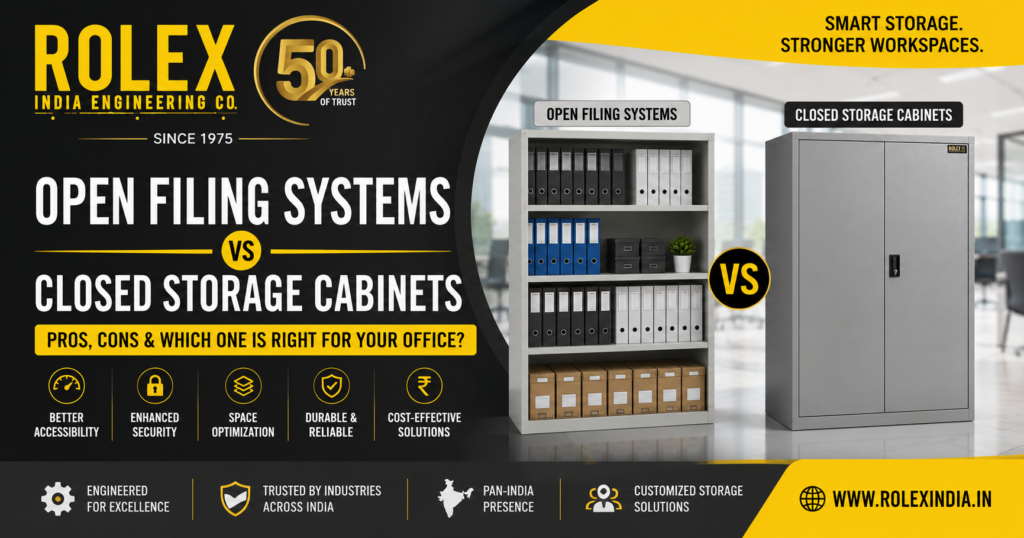
Open Filing Systems vs Closed Storage Cabinets: Pros, Cons & Which One Is Right for Your Office?
Efficient document storage is the backbone of every organized workplace. Whether you manage a corporate office, hospital, educational institution, government department, warehouse, or manufacturing facility, choosing the right filing solution directly affects productivity, security, and workspace efficiency.
Businesses often face one important question:
Should you choose an open filing system or a closed storage cabinet?
While both solutions are designed to organize documents and materials, they serve different operational needs. Open filing systems provide quick access and improve workflow efficiency, whereas closed storage cabinets prioritize security, privacy, and protection from dust and damage.
Selecting the wrong option can lead to cluttered workspaces, reduced productivity, and even compliance risks when handling confidential records.
With over 50 years of experience in manufacturing industrial storage solutions, Rolex India understands how different industries require different storage systems. Since 1975, the company has supplied high-quality filing cabinets, storage racks, lockers, and mobile compactor systems to businesses across India.
This comprehensive guide compares both storage solutions in terms of accessibility, security, durability, maintenance, cost, and real-world applications to help you make an informed investment.
What Are Open Filing Systems?
Open filing systems are storage units without doors, allowing users to access files, folders, binders, or documents instantly without unlocking or opening cabinets.
These systems are commonly designed using durable steel shelving and can accommodate various document sizes depending on organizational requirements.
They are widely used in environments where employees frequently retrieve and return files throughout the day.
Common Features
- Open shelf design
- Easy document visibility
- Quick retrieval
- Expandable shelving
- Heavy-duty steel construction
- Adjustable shelves
- Multiple storage capacities
Typical Applications
- Corporate offices
- Schools
- Universities
- Libraries
- Warehouses
- Record rooms
- Administrative departments
Benefits at a Glance
✔ Faster document retrieval
✔ Better workflow
✔ Lower purchase cost
✔ Easy organization
✔ Minimal maintenance
What Are Closed Storage Cabinets?
Closed storage cabinets are enclosed steel cabinets equipped with doors, locking systems, and multiple shelves or drawers for secure document storage.
These cabinets protect valuable records from unauthorized access, dust, moisture, and accidental damage.
Many organizations handling confidential information rely on closed cabinets to comply with internal security policies and regulatory requirements.
Common Features
- Lockable doors
- Adjustable shelves
- Powder-coated steel body
- Multiple locking mechanisms
- Dust-resistant storage
- High load capacity
- Long operational life
Common Industries
- Hospitals
- Banks
- Government offices
- HR departments
- Finance companies
- Legal firms
- Corporate offices
Key Advantages
✔ Higher security
✔ Dust protection
✔ Better document preservation
✔ Professional appearance
✔ Suitable for confidential records
Open Filing Systems vs Closed Storage Cabinets
Although both products organize documents, they are designed with different priorities.
| Feature | Open Filing System | Closed Storage Cabinet |
|---|---|---|
| Accessibility | Excellent | Moderate |
| Security | Low | Excellent |
| Dust Protection | Low | High |
| Cost | Lower | Higher |
| Organization | Excellent | Excellent |
| Privacy | None | High |
| Best for Daily Access | Yes | Moderate |
| Locking Facility | No | Yes |
| Maintenance | Easy | Easy |
| Professional Look | Good | Excellent |
Pros of Open Filing Systems
1. Faster File Retrieval
Employees can locate documents within seconds because everything remains visible and easily accessible.
This significantly improves operational efficiency in departments handling hundreds of files daily.
2. Better Workflow
Without cabinet doors or locks slowing down access, employees spend less time searching and more time completing productive work.
This is especially beneficial in:
- Accounts
- Administration
- Libraries
- Warehouses
3. Cost-Effective Solution
Open filing systems generally cost less than enclosed cabinets because they require fewer materials and simpler manufacturing.
Businesses setting up large record rooms often prefer open shelving for budget optimization.
4. Easy Expansion
Most open shelving systems can be extended as storage requirements grow.
Instead of replacing the entire unit, additional shelving sections can be installed.
5. Improved Visibility
Employees instantly know where files are stored, reducing misplaced documents and improving team collaboration.
6. Suitable for High-Volume Records
Organizations processing hundreds of files daily benefit from immediate accessibility.
Examples include:
- Hospitals
- Universities
- Municipal offices
- Warehouse
Cons of Open Filing Systems
Limited Security
Anyone can access documents, making them unsuitable for confidential information.
Sensitive files such as financial records, employee data, legal documents, or contracts should not be stored openly.
Dust Accumulation
Since documents remain exposed, they collect dust faster and require regular cleaning.
Dust can also shorten the lifespan of archived paper records.
Less Professional Appearance
Open shelving may appear cluttered if files are not consistently organized.
Using labels, dividers, and color-coded folders helps maintain a clean, professional look.
Pros of Closed Storage Cabinets
Closed storage cabinets are designed for organizations that prioritize document security, confidentiality, and long-term record preservation. They offer a controlled storage environment, protecting important files from unauthorized access, dust, moisture, and physical damage.
Let’s explore why many businesses prefer closed storage cabinets for sensitive records.
1. Enhanced Document Security
One of the biggest advantages of closed storage cabinets is their ability to protect confidential information. Most cabinets come with built-in locking mechanisms, ensuring that only authorized personnel can access important documents.
This makes them ideal for storing:
- Employee records
- Financial statements
- Legal contracts
- Medical files
- Government documents
- Client agreements
- Intellectual property
For industries handling sensitive information, secure storage isn’t just a convenience it is often a compliance requirement.
2. Superior Dust and Moisture Protection
Paper documents can deteriorate over time when exposed to dust, humidity, and environmental pollutants.
Closed storage cabinets significantly reduce exposure by enclosing files behind steel doors. This helps preserve important records for years without frequent maintenance.
Organizations maintaining archived documents for legal or regulatory purposes greatly benefit from this added protection.
3. Professional Office Appearance
A well-organized office creates a positive impression on employees, clients, and visitors.
Closed cabinets hide file clutter, giving workspaces a cleaner and more professional appearance.
This is especially important in:
- Corporate offices
- Reception areas
- Executive cabins
- Boardrooms
- Client-facing departments
A tidy office also contributes to better employee productivity and workplace satisfaction.
4. Better Long-Term Record Preservation
Some documents need to be stored for several years or even decades.
Closed cabinets protect these records from:
- Sunlight
- Dust accumulation
- Accidental spills
- Physical wear
- Frequent handling
When combined with high-quality steel construction and powder-coated finishes, they offer exceptional durability for long-term storage.
5. Supports Regulatory Compliance
Industries such as healthcare, banking, finance, legal services, and government organizations often have strict regulations regarding document storage and privacy.
Closed storage cabinets help businesses meet these compliance requirements by providing controlled access and secure storage.
6. Multi-Purpose Storage
Modern storage cabinets are no longer limited to paper files.
Businesses also use them for storing:
- Office supplies
- Employee belongings
- Electronic equipment
- Company assets
- Backup media
- Inventory records
This versatility makes them a valuable investment for almost every workplace.
Cons of Closed Storage Cabinets
Although closed storage cabinets provide excellent security, they may not be the perfect solution for every business.
Here are a few limitations to consider.
Slower Document Access
Employees need to unlock and open cabinet doors before accessing files.
In departments where hundreds of files are handled daily, this extra step can reduce operational efficiency.
Higher Initial Investment
Closed cabinets generally cost more than open filing systems due to:
- Steel doors
- Locking mechanisms
- Reinforced construction
- Additional manufacturing components
However, the long-term value often outweighs the initial cost for businesses handling confidential information.
Requires Better Space Planning
Cabinet doors need sufficient clearance to open fully.
In smaller offices, this should be considered during workspace planning to avoid obstructing walkways or workstations.
Slightly More Maintenance
Locks, hinges, and door mechanisms require occasional maintenance to ensure smooth operation over time.
Fortunately, high-quality cabinets from reputable manufacturers are built to withstand years of daily use with minimal upkeep.
Open Filing Systems vs Closed Storage Cabinets: Which Saves More Office Space?
Efficient use of office space is a growing concern, especially in urban workplaces where every square foot matters.
The answer depends on your storage goals.
Open Filing Systems
Open filing systems maximize vertical storage and allow employees to retrieve files quickly.
Advantages include:
- Easy shelf expansion
- Flexible layouts
- Better visibility
- Quick access
However, because files remain exposed, they may require wider aisles for easy movement.
Closed Storage Cabinets
Closed cabinets occupy a similar floor area but offer better organization through enclosed compartments.
They also reduce visual clutter, making offices appear more spacious and organized.
For businesses with limited office space, combining closed cabinets with vertical storage layouts delivers excellent results.
Security Comparison
| Security Factor | Open Filing System | Closed Storage Cabinet |
|---|---|---|
| Unauthorized Access | High Risk | Low Risk |
| Locking Mechanism | ❌ | ✔ |
| Confidential Files | Not Recommended | Highly Recommended |
| Dust Protection | Low | High |
| Long-Term Preservation | Moderate | Excellent |
| Data Privacy | Low | Excellent |
Winner: Closed Storage Cabinets
Cost Comparison
When comparing costs, businesses should evaluate the total cost of ownership rather than just the purchase price.
| Cost Factor | Open Filing System | Closed Storage Cabinet |
|---|---|---|
| Initial Cost | Lower | Higher |
| Maintenance | Low | Low to Moderate |
| Replacement Frequency | Low | Very Low |
| Document Protection | Moderate | Excellent |
| Return on Investment | High | Very High |
Although closed cabinets require a larger upfront investment, they often reduce long-term replacement costs by protecting valuable records more effectively.
Which Industries Should Choose Open Filing Systems?
Open filing systems are ideal for organizations that prioritize speed and accessibility over confidentiality.
Recommended Industries
Educational Institutions
Schools, colleges, and universities frequently access student records and administrative documents.
Open shelving improves workflow efficiency.
Warehouses
Inventory records and dispatch documents need quick retrieval.
Open filing systems support fast operations.
Libraries
Libraries manage thousands of files and catalog records that require constant access.
Manufacturing Companies
Production teams often access drawings, work orders, and inventory files throughout the day.
Administrative Departments
Departments handling routine paperwork benefit from immediate document visibility.
Which Industries Should Use Closed Storage Cabinets?
Closed storage cabinets are essential wherever confidential or regulated information is stored.
Hospitals
Patient records require strict privacy and secure storage.
Banks
Financial documents, loan files, and customer information must remain protected.
HR Departments
Employee records contain confidential personal information.
Government Offices
Official documents often require controlled access and long-term preservation.
Legal Firms
Case files and contracts must remain secure and protected from unauthorized access.
Corporate Offices
Executive documents, financial reports, and strategic business information are best stored in lockable cabinets.
Expert Buying Guide: How to Choose the Right Storage Solution
Before investing in office storage furniture, consider the following factors.
1. Document Sensitivity
Ask yourself:
- Are these confidential records?
- Who should have access?
- Is document privacy important?
If security is a priority, choose closed storage cabinets.
2. Frequency of Access
If employees retrieve files dozens of times every day, open filing systems improve productivity.
For archived records accessed occasionally, closed cabinets are more suitable.
3. Available Office Space
Measure your office layout carefully.
Consider:
- Door clearance
- Walking space
- Future expansion
- Vertical storage opportunities
4. Budget
Don’t evaluate storage furniture based only on purchase price.
Instead, consider:
- Expected lifespan
- Maintenance costs
- Replacement costs
- Security value
- Employee productivity
High-quality steel storage solutions provide better long-term value than inexpensive alternatives.
5. Future Growth
Choose storage systems that can grow with your business.
Modular shelving and expandable storage solutions offer greater flexibility as document volumes increase.
Why Choose Rolex India for Office Storage Solutions?
For over 50 years, Rolex India has been helping businesses across India create organized, secure, and space-efficient workplaces.
Our storage solutions are engineered for durability, functionality, and long-term performance.
We manufacture:
- Office Filing Cabinets
- Filing Racks
- Open Filing Systems
- Closed Storage Cabinets
- Mobile Compactor Storage Systems
- Heavy Duty Storage Racks
- Industrial Storage Solutions
- Lockers
- Staff Lockers
- Mobile Phone Lockers
- RFID Lockers
- Warehouse Storage Systems
- Customized Storage Solutions
Why Businesses Trust Rolex India
- Established in 1975
- Premium-quality steel construction
- Custom storage solutions
- Powder-coated corrosion-resistant finish
- Modern manufacturing facilities
- Pan-India supply
- Trusted by government, corporate, educational, healthcare, and industrial sectors
Whether you’re setting up a new office or upgrading your existing workspace, our experts can help you choose the right storage solution based on your operational needs.
Final Verdict
There is no universal winner between open filing systems and closed storage cabinets because each serves a different purpose.
Choose an open filing system if your priority is fast access, frequent document handling, and cost-effective organization.
Choose a closed storage cabinet if your business handles confidential information, requires secure storage, or needs long-term document preservation.
For many organizations, the best solution is a combination of both—using open filing systems for active records and closed storage cabinets for confidential or archived documents. This hybrid approach maximizes efficiency while maintaining security.
Investing in high-quality storage solutions is more than buying office furniture. It’s about improving productivity, protecting valuable information, and creating a workspace that supports long-term business growth.
Frequently Asked Questions
1. What is the difference between an open filing system and a closed storage cabinet?
An open filing system provides quick access to documents through open shelves, making it ideal for frequently used files. A closed storage cabinet features lockable doors that protect confidential documents from unauthorized access, dust, and environmental damage.
2. Which is better for office document storage?
It depends on your business requirements. Open filing systems are suitable for fast document retrieval, while closed storage cabinets are better for secure and long-term document storage.
3. Are closed storage cabinets more secure?
Yes. Closed storage cabinets include locking mechanisms that help protect sensitive files, financial records, employee information, and confidential business documents.
4. Do open filing systems save space?
Open filing systems efficiently utilize vertical storage and provide quick visibility of files. They are particularly useful for organizations handling a large volume of daily paperwork.
5. Which industries should use open filing systems?
Open filing systems are widely used in:
- Educational institutions
- Warehouses
- Libraries
- Manufacturing units
- Administrative offices
- Record rooms
6. Which industries require closed storage cabinets?
Closed storage cabinets are ideal for:
- Hospitals
- Banks
- Government departments
- Corporate offices
- HR departments
- Legal firms
- Financial institutions
7. Which storage solution lasts longer?
Both systems are highly durable when manufactured using premium-quality steel. Proper maintenance significantly extends their lifespan.
8. Are steel storage cabinets better than wooden cabinets?
Yes. Steel cabinets offer superior durability, fire resistance, corrosion resistance, security, and lower maintenance compared to traditional wooden cabinets.
9. Can businesses use both storage systems together?
Absolutely. Many organizations combine open filing systems for active records with closed storage cabinets for confidential or archived documents to maximize efficiency and security.
10. How do I choose the right filing system?
Consider the following:
- Document sensitivity
- Frequency of access
- Available office space
- Security requirements
- Budget
- Future expansion needs
11. Are closed storage cabinets dust-proof?
While not completely airtight, closed storage cabinets significantly reduce dust accumulation and help preserve important documents for longer periods.
12. What material is best for office storage cabinets?
Heavy-duty powder-coated steel is considered the industry standard because it offers excellent strength, corrosion resistance, and a long service life.
13. Can filing systems improve office productivity?
Yes. Organized storage reduces document retrieval time, minimizes clutter, and helps employees work more efficiently.
14. How often should office storage systems be maintained?
Routine inspections every 6–12 months, along with regular cleaning and lubrication of locks and hinges, are generally sufficient to keep storage systems in good condition.
15. Why choose Rolex India for storage solutions?
Rolex India has been manufacturing high-quality industrial and office storage solutions since 1975, offering durable, customizable, and space-efficient products trusted by businesses across India.

Related posts